Precautionary Landing Pattern (PLP)
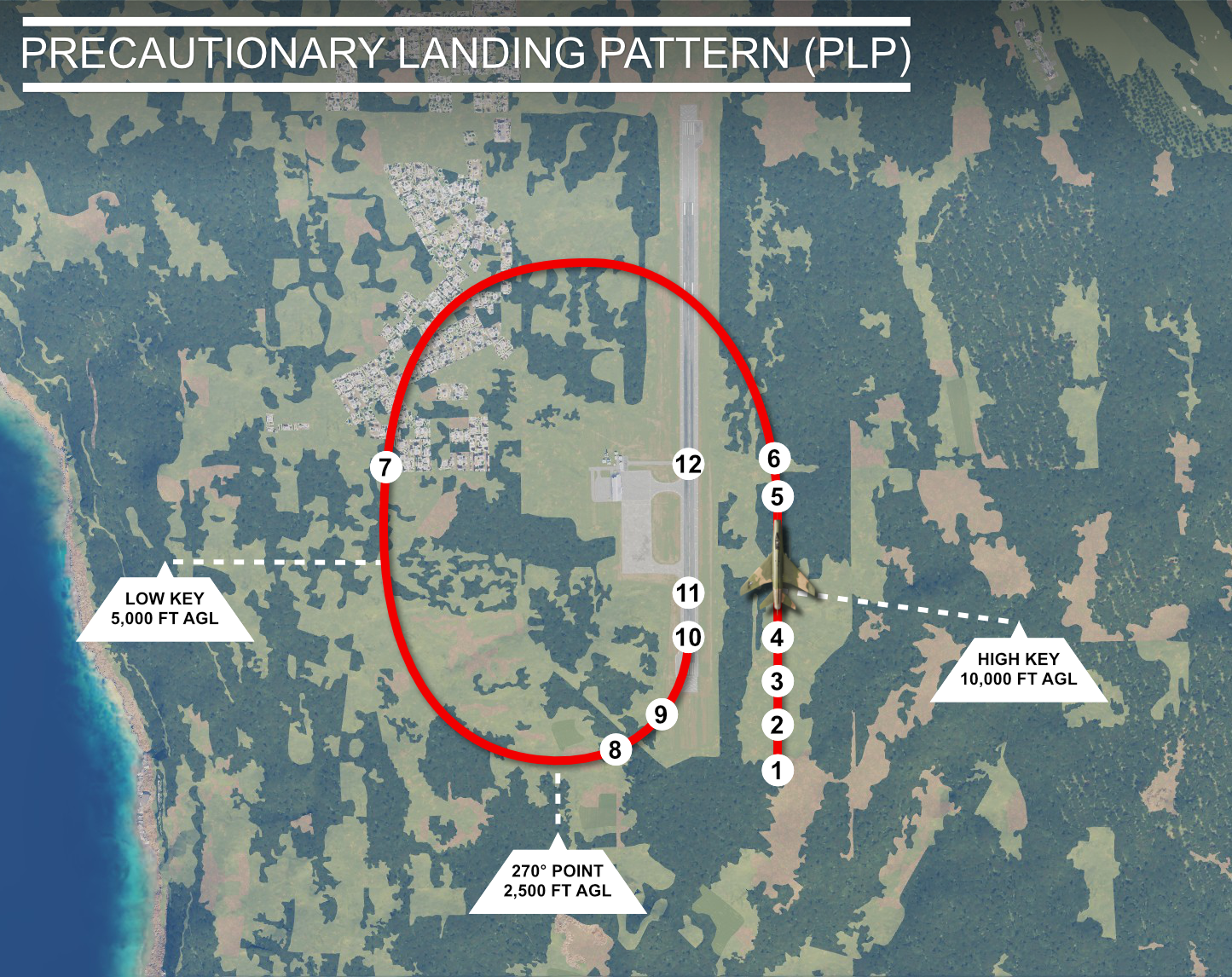
The prime objective of the precautionary landing pattern (PLP) is to get the aircraft on the runway on the first attempt. The PLP is designed to keep the pilot in a safe ejection envelope while providing checkpoints with required energy states to land on the runway.
Basic consideration when executing a PLP are:
- Do not descend below minimum safe ejection altitude until required for approach and landing.
- Fly as near the normal 2–3° approach to landing as possible.
- Eject whenever the situation begins to deteriorate to a point where the desired safe approach cannot be made.
Note
The PLP is slightly larger than the normal landing pattern and can be entered on downwind, base or final approach.
- External Load—JETTISION.
- Engine Master and Generator Switches—OFF.
- Fuel System Shutoff—OFF.
- Emergency Hydraulic Pump Lever (RAT)—ON.
- Shoulder Harness—LOCK.
- Landing Gear—DOWN.
-
Airspeed—220 KIAS—Hold a constant speed of 220 KIAS in the pattern until on final. Fly a pattern. Varying flight path to make key points. Aim for one third point of runway.
Warning
Avoid excess use of controls, especially ailerons: control is marginal due to reduced hydraulic flow.
-
Airspeed—200 KIAS—Hold pattern speed through final turn, playing the turn "long" or "short", for accurate touchdown. Reduce airspeed to 200 KIAS when straight in on final and maintain into flare.
-
Wing Flaps—AS REQUIRED.
Caution
With a dead engine, speed brake is inoperative.
-
Drag Chute—DEPLOY.
-
Nose Wheel Steering—ENGAGE.
Warning
Nose wheel steering is unreliable due to reduced hydraulic flow at low windmill RPM during landing.
-
Battery Switch—OFF.
Ultimately, pilot evaluation of variables determines pattern and entry point requirements. Here are some generally applicable procedures for a final approach:
- The landing gear should be down, the flaps down, and the RAT extended (if applicable).
- Maintain a normal glide path of 2–3° and recommended computed final approach speed.
- Avoiding excessive rate of descent.
- Use power as necessary to transition to a normal flared landing.