Landing
Before Landing
On approach:
- Hydraulic pressures—CHECK. Monitor utility system during approach and landing.
- Safety belt and should harness—TIGHTENED
- Anti-Skid Switch—ON
- Speed Brake—AS REQUIRED
- Landing Gear—DOWN—Check for down and locked indications.
- Wing Flaps—DOWN—Flaps alone will provide sufficient drag. However, speed brake may be also be used.
Normal Landing
- Throttle—IDLE—During flare or at touchdown.
- Touchdown
- Wing Flaps—UP
-
Nose Wheel Steering—ENGAGE
Caution
In the event of a nose wheel steering system malfunction, disengage and maintain directional control with rudder and differential braking.
Warning
If the rudder pedals are not neutral when the nose wheel steering button is pressed, the steering may not engage. If the steering does not engage, move the rudder pedals in the direction of the nose wheel setting. To prevent nose wheel steering disengaging because of pitching, hold forward stick pressure on landing roll out.
-
Drag chute—DEPLOY
- Employ normal braking
- Speed brake—UP
Normal Landing Technique
Gear should be lowered below 230 KIAS to avoid damage.
As an example, with a 24,000-pound aircraft:
- The pattern should be flown 20 KIAS above the final approach speed.
- An RPM of 83–87% is required. Arrive on final at 165 KIAS, 300 feet AGL, and one nautical mile from the runway. This results in a glide path between 2.5–3°, with an impact point just short of the runway.
Small adjustments of airspeed can be corrected with pitch and small adjustments in descent rate can be corrected with throttle. However, larger adjustments must be made with coordinated use of both throttle and speed brake. To achieve a precise touchdown point in the flare, maintain a stable descent rate and airspeed. Reduce thrust the thrust as necessary prior to touchdown.
Note
10 knots fast equates to approximately an additional 1000 feet of ground roll.
Speed Brake Operation
Speed brake operation in addition to flaps, or alone, the aircraft buffet will increase. Flaps provide sufficient drag resulting in an appropriate flat approach with high power settings. Thus, use of speed brake is not necessary unless required.
Flap Technique
Raising the flaps immediately after touchdown will increase the normal load on the nose and main landing gear, allowing the brakes to produce a higher braking moment. This will provide higher deceleration.
Drag Chute Operation
The drag chute (in real life) has been tested up to 180 KIAS without failure. Thus, reliability is greatly increased at lower speeds if the aircraft is allowed to slow below 150 KIAS before deploying the drag chute.
Tail Skid
The tail skid is installed only for the purpose of protecting the aircraft from serious damage in the tail area during landing. Occasional contact of the tail skid is normal operation. However, the tail skid may not protect the aircraft under high sink rates.
Landing Pattern
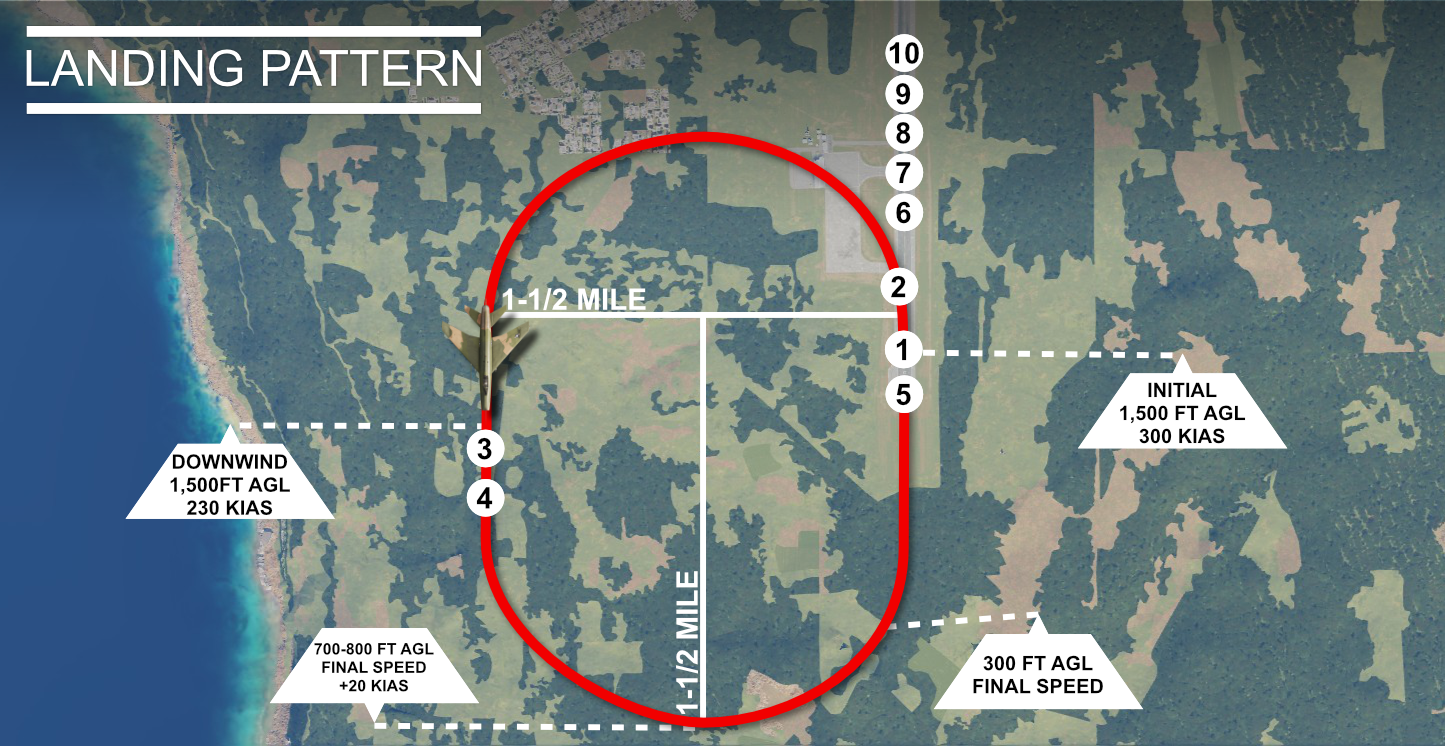
- Initial—300 KIAS
- Speed Brake—AS REQUIRED—Position throttle to maintain pattern speed and altitude
- Landing Gear—DOWN—Checked for down-and-locked indications.
- Wing Flaps—DOWN
- Throttle—IDLE—Touchdown at recommended speed.
- Wheel Brakes—CHECK
- Wing Flaps—UP
- Nose Wheel Steering—ENGAGE
- Drag Chute—DEPLOY
- Speed Brake—UP
Landing Without a Drag Chute
Sufficient braking is available without the drag chute on a dry runway. Aerodynamic braking can also be used to dissipate energy down to a speed where mechanical braking is much more effective with less energy absorption.
Minimum-run Landing
Minimum-run landings should be preformed in the following manner: touch down at the recommended speed for weight and configuration, lower the nose wheel as soon as the main gear make contact with the runway, engage nose wheel steering, retract the flaps, and deploy the drag chute. Apply a steady but light force to use brakes as required and increase as the aircraft slows. Once the flaps are fully retracted or the aircraft is slower than 110 KIAS, heavier braking may be used. If the anti-skid system cycles or skids, release brake pressure.
Note
No damage is being done if the anti-skid system cycles, however every cycle or skid increases stopping distance by 10%.
Note
With anti-skid on, if full brakes are used until a complete stop, abrupt pitching may results. If this is the case, decrease pedal pressure.
Slippery Runway Landing
On a slippery runway, braking action will vary immensely. Use anti-skid and aerodynamic braking to the max extent possible. The drag chute should be deployed while aerodynamically braking. Rudder is the primary means of directional control as nose wheel steering and braking may be ineffective. Rudder control is available down to 60 KIAS.
Landing In Crosswinds
When landing in crosswinds, approach and touchdown speeds should be increased. Increase speeds by ½ the crosswind velocity component plus ½ the gust factor. For example, a 45° off runway crosswind of 10 knots gusting 20 knots, approach speed should be increased by 10 knots.
On final, crab into the wind or forward slip to align the fuselage with the runway. If crabbing, perform a forward slip before touchdown. If the crosswind component exceeds 25 knots, perform a no-flap landing. At touchdown, lower the nose wheel and engage nose wheel steering. A higher tendency of weather vaning into the wind exists when the drag chute is deployed. Thus, careful consideration that the nose wheel steering is operating before deploying the drag chute is essential. If directional control is lost, the drag chute must be jettisoned.
Caution
If the rudder pedals are not neutral when the nose wheel steering button is pressed, the steering may not engage. If the steering does not engage, move the rudder pedals in the direction of the nose wheel setting.
Touch and Go Landing
- Normal touchdown.
- Throttle—MIL
- Speed brake—UP
- Wing Flaps—INTERMEDIATE
Caution
Exercise care when moving the flaps to INTERMEDIATE. Moving the flaps to UP will necessitate increased rotation speed.
- Trim the aircraft for takeoff.
- Nose rotation—At rotation speed, begin to slowly rotate the aircraft so that the aircraft will assume the pitch angle required for takeoff at the takeoff speed.
Warning
Ensure proper airspeed has been obtained before rotation. Do not rotate the aircraft excessively nose high. If over rotated, reduce the angle of attack back to the proper takeoff pitch attitude.
- Takeoff—Maintain proper takeoff pitch attitude after lift off until proper airspeed is obtained as to prevent settling.
- Landing Gear—UP
- Wing Flaps—UP—Increase pitch angle during flap retraction, to prevent settling.
Other
Airplane response is sluggish at landing speeds and more stabilizer deflection is required for similar responses. High instantaneous demand above available rate will stick may stiffen or lock up. This only means the stabilizer is moving at the maximum available rate and does not mean the stabilizer has stopped moving, but the pilot is demanding a higher rate. This can be avoided by flying a smooth power-on approach and reducing over control. It is possible to over control to the point where the hydraulic system will meet the criteria to illuminate the FLIGHT SYS FAIL caution light. The illumination of the caution light and stick stiffening can occur independently. Refer to the hydraulic system section for more information on the conditions of the FLIGHT SYS FAIL caution light. Stick force lightning occurs 5 KIAS below the touchdown speed of the 1G condition. If encountered, stick force lightning is not dangerous and normal flying should be continued. Over controlling or "jamming" can cause porpoising. Excessive sink rate, airspeed, descent rate, or a combination of all three can also cause porpoising. Excessive touchdown speed may cause the nose wheel to touchdown first, which may induce an excessively nose high response. Pushing forward will cause the cycle to be repeated. If porpoising is encountered, hold the stick slightly aft of neutral while advancing the throttle to execute a proper go around procedure. Attempting to counteract the porpoising will only aggravate the aircraft response.
Caution
If using aerodynamic braking in crosswind conditions, rudder authority may be insufficient to prevent weather vaning. The crosswind landing procedure should be used.